


























The Evolution of NOC: From Reactive Monitoring to AI-Driven Operations
Downtime Isn’t Just Technical - It’s Financial
For years, Network Operations Centers (NOCs) have operated in a reactive mode – waiting for alerts, responding to incidents, and racing against time to restore systems.
But in today’s always-on, digital-first world, that approach no longer works.
Downtime doesn’t just interrupt systems – it impacts revenue, customer trust, and business continuity.
The shift is clear: from reacting to failures – to preventing them before they happen.
Why Reactive NOC Models Are Failing
Traditional NOCs rely heavily on alerts and manual intervention. The result?
- Delayed issue detection leading to prolonged downtime
- Alert fatigue causing missed critical incidents
- Lack of visibility across hybrid and multi-cloud environments
- Increased Mean Time to Resolution (MTTR)
- Rising operational costs due to inefficiencies
In a landscape where every second matters, reacting after the impact is already too late.
The Shift to AI-Driven NOC Operations
Modern enterprises are transforming their NOC with AI-driven intelligence and automation-moving from reactive monitoring to proactive, predictive operations.
What’s Changing?
- From Alerts – To Insights
AI correlates thousands of events to identify real issues, not just noise. - From Manual Response – To Automated Action
Routine issues are resolved automatically without human intervention. - From Visibility Gaps – To Full-Stack Observability
End-to-end visibility across networks, applications, and cloud environments. - From Downtime – To Continuous Availability
Predictive analytics identifies risks before they become incidents.
How AI-Driven NOC Works in Practice
Instead of waiting for a failure:
- AI models continuously analyze system behavior in real time
- Anomalies are detected before they escalate
- Root causes are identified instantly using pattern recognition
- Automated workflows trigger immediate resolution actions
Before:
Issue detected after outage – Manual diagnosis – Delayed resolution
After:
Anomaly detected early – Instant analysis – Automated fix – No business impact
Why It Matters Now
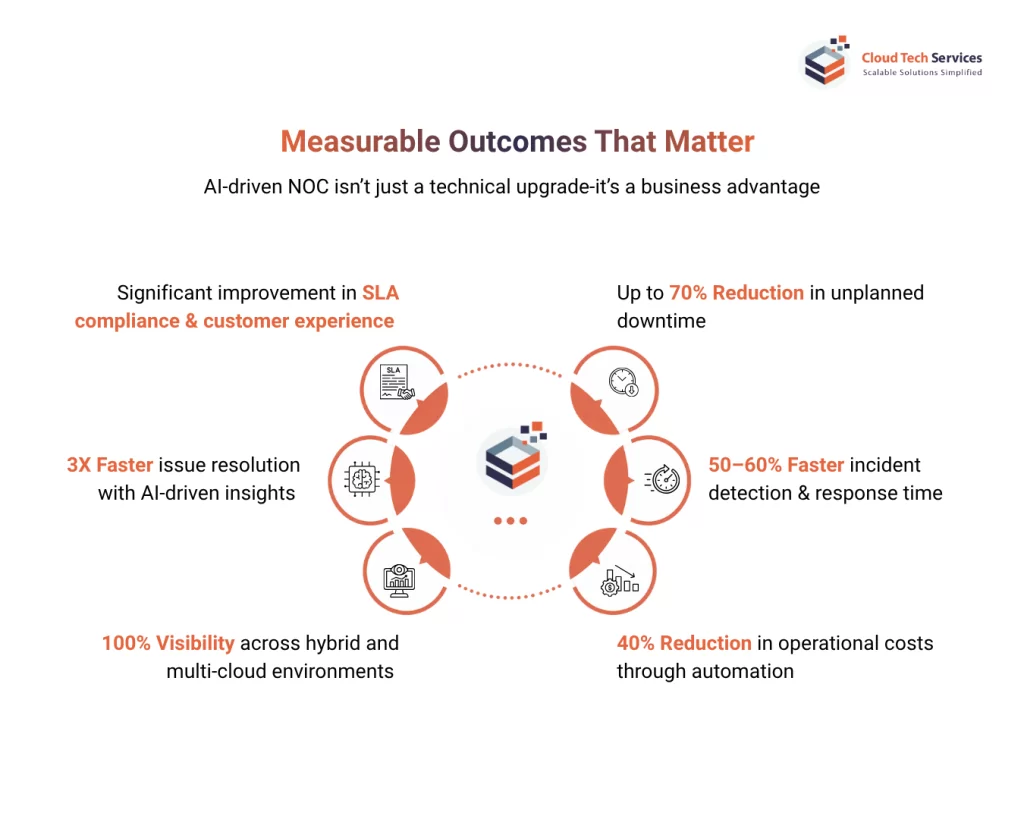
As IT environments grow more complex-with hybrid infrastructure, cloud adoption, and distributed systems-traditional monitoring simply can’t keep up.
Businesses need:
- Real-time intelligence
- Proactive risk mitigation
- Always-on performance
AI-driven NOC delivers all three-transforming IT operations into a strategic business enabler.
Why Cloud Tech Services
Cloud Tech Services brings next-generation NOC capabilities powered by AI, automation, and deep observability.
- 24×7 intelligent monitoring across your IT ecosystem
- Predictive analytics to prevent disruptions before impact
- Automated incident response for faster resolution
- Scalable support for hybrid and multi-cloud environments
We don’t just monitor-we anticipate, act, and optimize.
The future of NOC is not reactive-it’s predictive, intelligent, and autonomous.
Organizations that embrace this shift don’t just reduce downtime-
they gain resilience, efficiency, and a competitive edge.
Ready to move beyond reactive IT?